

A deepfake detector builtfor evidence, not for a score
Most deepfake detection tools return a single number from a single model. Exiphore examines an exhibit across eight independent families of forensic evidence, states what each one can and cannot establish, and produces a record an examiner can sign and defend under cross-examination.
What is a deepfake detector?
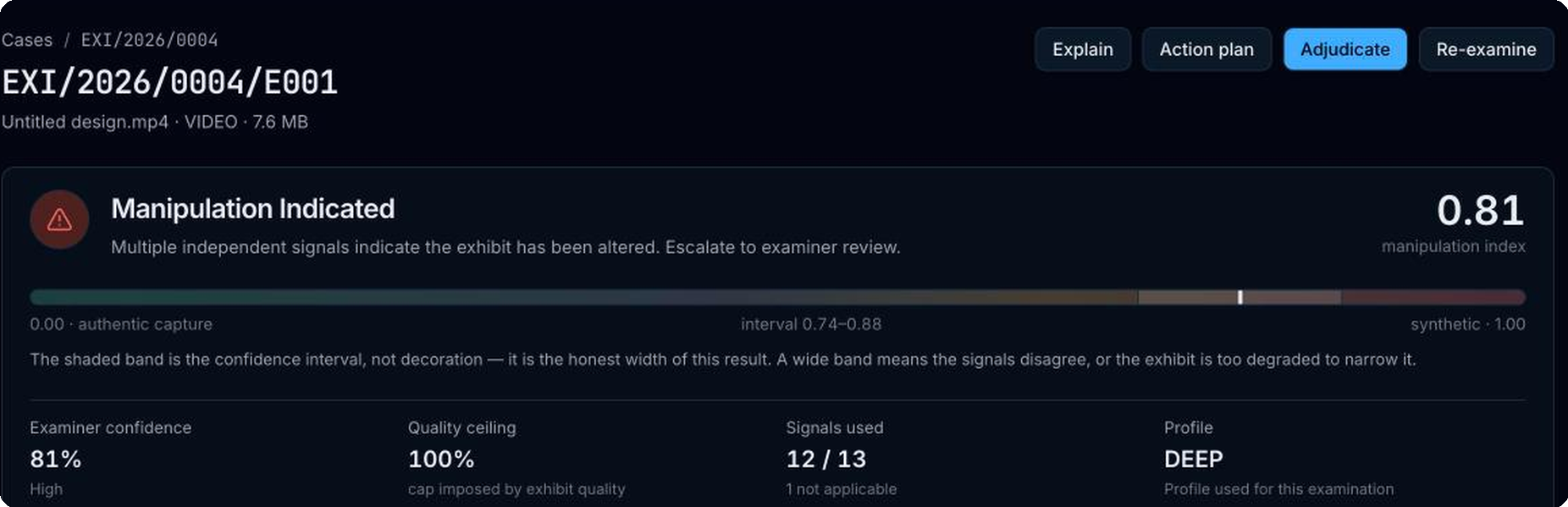
A deepfake detector is software that examines a piece of media — video, an image, an audio recording or a document — for evidence that it was generated or altered by AI rather than captured by a camera or a microphone. It does this by measuring properties that a genuine recording has and a synthesised one struggles to reproduce: physiological signals such as a pulse visible in the skin, the frequency structure a real sensor leaves behind, temporal consistency between frames, compression and editing traces, cryptographic provenance, and the output of learned classifiers trained on known manipulations.
The distinction that matters in practice is between a detector that returns a probability and a forensic examination that returns a finding. A probability cannot be interrogated, cannot state its own limits, and does not survive being questioned. Exiphore is built as the second kind: every measurement is shown, every limitation is recorded in band, and no result is released as an expert opinion until a named examiner has reviewed it and signed.
What Exiphore detects
Synthetic media does not arrive as one problem. Each medium carries different evidence, and each is examined by the measurements appropriate to it.
Video
Face swaps · lip-sync and talking-head generation · full synthesis · re-encoded and redistributed clips
Physiological pulse recovered from facial regions, blink dynamics, temporal coherence between the face and the scene behind it, audio-visual synchrony, learned lip-sync analysis and generator fingerprints in the frequency domain.
Images
Diffusion and GAN-generated imagery · splicing and compositing · retouched and altered photographs
Spectral structure against the natural power law, error-level analysis, sensor noise consistency, face-blending boundaries, embedded metadata and generator markers, and a learned classifier scored through the deployed preprocessing.
Audio
Voice cloning and text-to-speech · spliced recordings · synthetic call audio
High-band energy, pitch jitter and shimmer, noise-floor structure and the spectral artefacts that vocoders and neural synthesisers leave behind — with the ceiling that telephone-band audio imposes stated explicitly.
Documents and text
Forged records · altered PDFs · fabricated correspondence
Container and revision structure, what a signature actually covers, embedded imagery examined in its own right, and the difference between ordinary editing and substantive alteration.
How to judge a deepfake detector
There is no single best deepfake detector, and any vendor claiming to be one is telling you something it cannot evidence. These are the seven questions worth asking of anything you are considering — ours included.
- 01
Does it measure more than one kind of evidence?
A single learned classifier generalises poorly to generation methods absent from its training data — the documented weakness of the entire detector family. Independent families of evidence fail independently, which is the only reason combining them helps.
- 02
Can it say 'inconclusive'?
A tool that always returns an answer is guessing on the cases where the evidence does not discriminate. Inconclusive has to be a real, reportable finding, with the reason attached.
- 03
Does it report an interval, and a quality ceiling?
A point estimate hides how much the exhibit itself limited the examination. A 95-pixel-wide face in a re-encoded clip cannot support a confident result, and the tool should say so rather than quietly returning one anyway.
- 04
Can it infer authenticity from what it did not find?
It must not. A detector that finds none of its particular artefact has described exactly what a wholly generated exhibit also looks like. Absence of evidence is not evidence of absence, and signals that can only evidence manipulation should be constrained so they can never assert the opposite.
- 05
Does it survive redistribution?
Real exhibits arrive re-encoded through messaging apps and social platforms, stripped of metadata and provenance. Accuracy measured on pristine research media tells you very little about accuracy on what actually reaches a case file.
- 06
Does it produce a record or a score?
For any evidential use the output has to carry the measurements, their stated limitations, a tamper-evident chain of custody and a named examiner's signed reasoning. A number in a web interface is not tenderable.
- 07
Does it run where the evidence lives?
Uploading case material to a third-party service is unlawful or impossible for most agencies. On-premises and air-gapped operation is not a preference, it is a precondition.
Where the difference actually lies
Against a single deepfake detector, and against the conventional forensic tooling a laboratory already runs.
| Capability | Single detector | Conventional forensic suite | Exiphore |
|---|---|---|---|
| Detects AI-generated media | Yes | partialPartial | Yes |
| Multiple independent evidence families | No | Yes | Yes |
| Related measurements de-correlated before pooling | No | No | Yes |
| Confidence interval rather than a point score | No | No | Yes |
| Exhibit quality caps achievable confidence | No | No | Yes |
| Reports disagreement instead of averaging it | No | No | Yes |
| Cannot infer authenticity from absent artefacts | No | partialPartial | Yes |
| Sealed, hash-chained chain of custody | No | Yes | Yes |
| Cross-case fingerprint linking | No | partialPartial | Yes |
| Named examiner adjudication before release | No | Yes | Yes |
| Court-ready report | partialPartial | Yes | Yes |
| Air-gapped deployment | partialPartial | Yes | Yes |
| Validation limits published, not just headline accuracy | No | partialPartial | Yes |
Measured detection performance
Measured end-to-end through the deployed pipeline rather than on the classifier in isolation, because the second number is the one a vendor quotes and the first is the one you actually get.
0.983
Classifier ROC-AUC
through deployed preprocessing
86.7%
Manipulated exhibits flagged
end-to-end, after fusion
0.0%
Authentic exhibits wrongly flagged
false-alarm rate
Inconclusive
Undetected manipulations
never wrongly cleared
Sample: 60 balanced images from the public Hemg/deepfake-and-real-images corpus, engine version 1.0.0. A small sample of still images from one corpus is a floor on discrimination, not a performance guarantee for casework. Full methodology.
Deepfake detection questions
What is the best deepfake detector?
There is no single best deepfake detector, because detectors differ in what they measure, what media they handle, and how they behave when the evidence is poor. A more useful question is whether a tool measures several independent families of evidence, reports a confidence interval rather than a single score, can return inconclusive, refuses to infer authenticity from artefacts it did not find, and produces a record an examiner can sign. Exiphore is built against all five, and publishes the conditions behind its own accuracy figure so it can be checked rather than taken on trust.
Is there a free deepfake detector?
Free online deepfake detectors exist and are useful for casual curiosity, but they are not suitable for evidential work: they require uploading the material to a third party, return a single unexplained score, keep no chain of custody, and state no limitations. For anything that may end up in a case file, the output has to be defensible, and that means measurements, stated limits, custody and a named examiner. Exiphore is licensed to institutions and deployed on their own infrastructure.
How accurate is deepfake detection?
Accuracy depends far more on the exhibit than on the tool. On a balanced 60-image sample of the public Hemg/deepfake-and-real-images corpus, measured end-to-end through its deployed pipeline, Exiphore flagged 86.7% of manipulated exhibits with a 0.0% false-alarm rate and returned undetected manipulations as inconclusive rather than clearing them. That is a small sample of still images from one corpus. Detection rates fall substantially on compressed, re-encoded and platform-redistributed media, and all learned detectors generalise poorly to generators absent from their training data.
Can a deepfake detector work on a WhatsApp or social media video?
Partly, and the honest answer is that redistribution destroys evidence. Re-encoding strips metadata, removes any provenance layer, and attenuates the frequency and compression traces a detector relies on. Exiphore still examines such exhibits — most casework material arrives this way — but it measures the damage and caps the confidence any result is allowed to carry, rather than reporting the same certainty it would on an original.
What is a synthetic media detector?
Synthetic media detector is the broader term for the same category. Deepfake usually implies a manipulated human face or voice, whereas synthetic media covers everything machine-generated: fully generated video with no real subject, cloned speech, AI-generated imagery, fabricated documents and synthetic identities. Exiphore examines all of these, and reports which family of evidence supported the finding in each case.
Can deepfake detection results be used as evidence in court?
An automated detection result is not an expert opinion on its own, in any jurisdiction. What can be tendered is a forensic examination: the measurements taken, their stated limitations, a tamper-evident chain of custody linking the finding to a specific set of bytes, and a qualified examiner's recorded reasoning and signature. Exiphore is built to produce exactly that record, and is explicit in it about what the examination cannot establish.
Can Exiphore detect AI-generated images and video from newer models?
In part, and the limit is worth stating plainly. Learned classifiers only recognise what resembles their training data, so a generator released after the model was trained may evade that signal entirely. This is why Exiphore does not rely on a learned classifier alone: physiological, frequency, temporal and provenance evidence do not depend on having seen a particular generator before, and a new method has to defeat all of them at once rather than just one.
Do I need to upload evidence to use Exiphore?
No. Exiphore is installed on your own infrastructure and can run fully air-gapped. Evidence never leaves your estate, there is no hosted tier and no external service in the examination path. The only component that can call an external model is optional narrative generation, which never touches the verdict or any measurement and can be disabled entirely.
How do I detect a deepfake video myself?
Visual inspection is unreliable and getting worse — the artefacts people are told to look for, such as unnatural blinking or blurred face edges, are exactly what each generation of tools fixes first. What is still worth doing before any technical examination is investigative rather than visual: preserve the original file rather than a re-shared copy, capture the source account and posting time, look for an earlier or higher-quality version of the same footage, and note whether the claim is corroborated anywhere else. Those steps hold up even when a detection result does not.
Bring us an exhibit you already know the answer to
The most useful evaluation of any deepfake detector is on your own material, from a closed case where the ground truth is settled. We will walk through what it finds, what it misses, and what it refuses to conclude.
Request a demonstration